SCORE
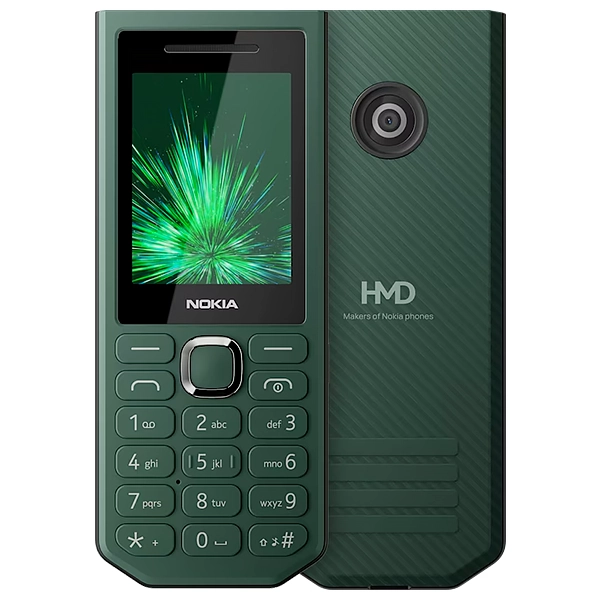
 Green
Green
 Sandstone
Short Overview
PROS
- 1 Exceptional 3700 mAh battery with reverse charging capability.
- 2 Durable design featuring a practical dedicated LED flashlight.
- 3 Modern USB Type-C port for convenient charging and data transfer.
CONS
- 1 Very basic QVGA camera with no front-facing option.
- 2 Limited internet capabilities (2G only, no Wi-Fi).
- 3 No support for modern smartphone applications or GPS navigation.
Prices
Questions and opinions
With a 3700 mAh battery, it offers extended talk and standby times, likely lasting several days on a single charge.
Yes, it supports 2G GPRS/EDGE for very basic internet access, but not for browsing complex websites or streaming.
No, as a feature phone, it does not support smartphone apps like WhatsApp; it's limited to SMS and basic built-in functions.
It features a very basic QVGA main camera, suitable for simple, low-resolution photos.
The Nokia 300 Charge enters the market as a focused feature phone, prioritizing durability, essential communication, and impressive battery life. Its design is straightforward and functional, measuring 136.6 x 55 x 15 mm and weighing 138g, making it comfortable for everyday handling. A notable addition is the dedicated LED flashlight positioned on top, enhancing its utility in practical situations. The phone supports Dual SIM (Mini-SIM) and comes in Green, Sandstone, and Black color options, offering a classic aesthetic.
Equipped with a 2.4-inch TFT display, the Nokia 300 Charge presents a resolution of 240 x 320 pixels. While this screen is modest compared to modern smartphones, it is perfectly adequate for a feature phone, providing clear visibility for calls, messages, and menu navigation. The user interface is designed for simplicity, ensuring ease of use for those who prefer a less complicated mobile experience. This display serves its purpose effectively without unnecessary frills.
Under the hood, the Nokia 300 Charge is powered by a Unisoc SC6531E chipset, paired with 4 MB of RAM and 4 MB of internal storage, which is expandable via a microSDHC card. This configuration is optimized for the demands of a feature phone, efficiently handling core tasks such as making calls, sending SMS messages, and running basic pre-installed games. Connectivity is limited to 2G GSM networks with GPRS and EDGE support, catering to fundamental communication needs without offering advanced internet browsing capabilities.
For capturing moments, the device includes a basic QVGA main camera. As is common for feature phones, it does not feature a selfie camera. Multimedia capabilities include an MP3 player for audio entertainment and a selection of games. A 3.5mm headphone jack is present for private listening, and a loudspeaker allows for hands-free calls and shared audio. The focus here is on essential functions rather than advanced photographic or multimedia experiences.
One of the most compelling aspects of the Nokia 300 Charge is its substantial 3700 mAh removable Li-Ion battery. This large capacity, combined with the power-efficient nature of a feature phone, promises exceptional battery life, potentially lasting several days on a single charge. Unusually for a feature phone, it supports 10W wired charging and, remarkably, 10W reverse wired charging, allowing it to function as a power bank for other devices. Connectivity options include a modern USB Type-C port for charging and data transfer, but it lacks Wi-Fi, GPS, and NFC, and Bluetooth specifications are unspecified.